If you're waiting for a clear sign that it's safe to buy, here's the honest answer: nobody rings a bell when the bottom hits. By the time it's obvious, it's already over. So the real question isn't

Dated: August 26 2026
Views: 19
If you're waiting for a clear sign that it's safe to buy, here's the honest answer: nobody rings a bell when the bottom hits. By the time it's obvious, it's already over. So the real question isn't “has the market bottomed?” — it's “what's actually true about the GTA right now, and does that work for me?”
Two things are true at the same time, and most of what you'll read online only covers one of them.
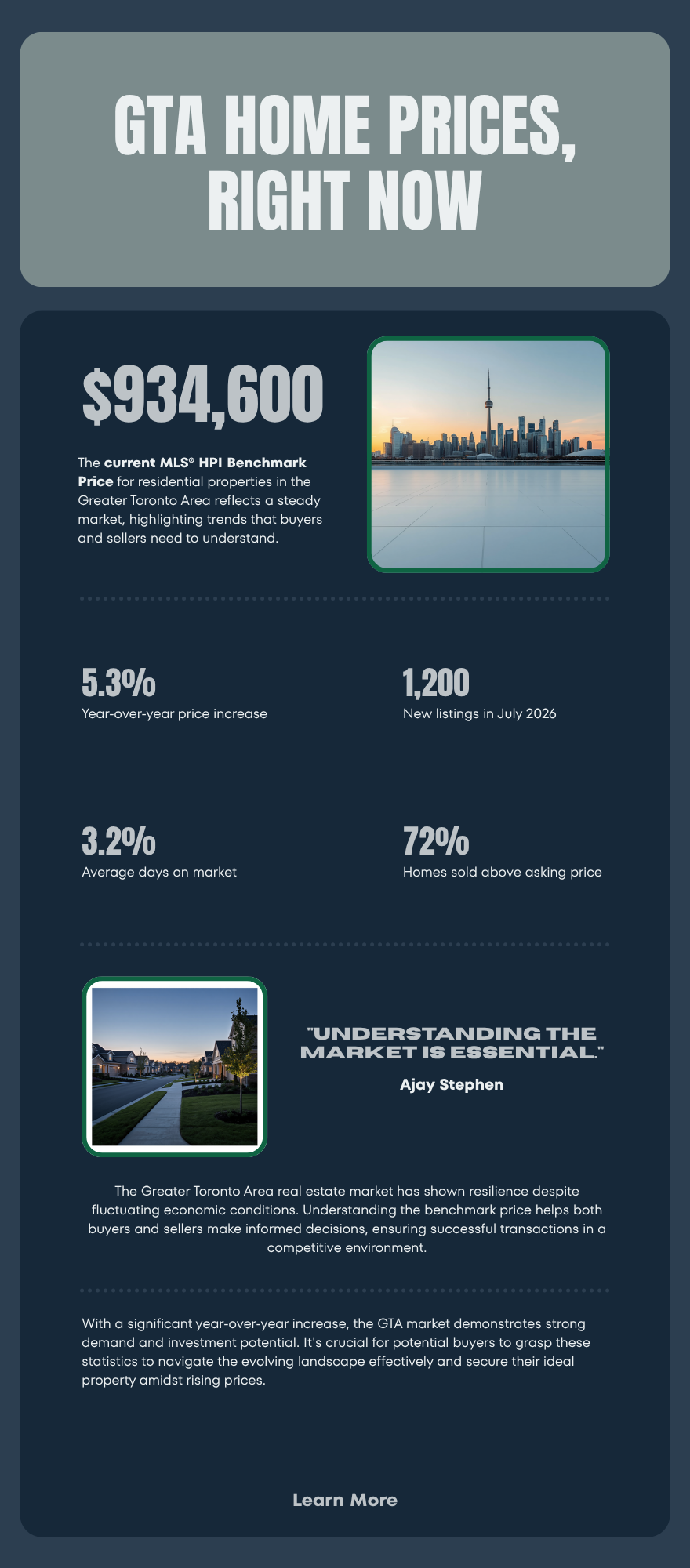
First, prices are still soft. As of TRREB's July 2026 Market Watch, the average GTA sale price sits around $1,003,956, with the MLS® HPI benchmark closer to $934,600 — both well off the highs of a few years ago. If you've been assuming Toronto is untouchably expensive, the current numbers are gentler than you might expect.
Second, new listings are down meaningfully compared to last year. That's the part that changes the calculus. Fewer homes coming onto the market means less to choose from — and historically, that's the setup that precedes prices firming back up, not softening further.
Soft prices plus shrinking inventory is not a combination that tends to last. It's not a “buy today or regret it forever” situation — but it's also not a “you have all the time in the world” situation either.
Waiting for the bottom assumes you'll recognize it when it happens. In practice, most buyers realize the bottom has passed only once competition picks back up and their options have already narrowed. The better question to ask yourself isn't about market timing at all — it's about your own number.
Does a home in your target neighbourhood work for your budget today, at today's prices, with today's rates? If the answer is yes, the macro debate about whether prices have another 2% to fall matters a lot less than you'd think. If the answer is no, no amount of “perfect timing” fixes that — the conversation needs to be about your number, not the calendar.
For buyers, the current mix of soft pricing and tightening inventory means there's still real negotiating room — but it's shrinking, not growing. Homes that are priced honestly and show well are starting to see more competition than they did six months ago, particularly in the $700K–$900K range where a lot of first-time and move-up buyers are concentrated.
That doesn't mean rush into a purchase that doesn't fit. It means the “I'll just keep watching for a while longer” approach is quietly getting more expensive every month inventory keeps shrinking. If your number already works, this is a reasonable window. If it doesn't yet, that's useful information too — better to know now than after a bidding war.
Nobody — not me, not a headline, not a forecast — can tell you with certainty whether Toronto prices go up or down 3% from here. What can be said honestly: inventory is thinning while prices remain accessible relative to recent history, and that combination has historically been temporary. Whether that means “buy now” depends entirely on your specific budget, your timeline, and what you're trying to buy — not on a market-wide prediction.
If you're trying to figure out whether your number actually works in the GTA right now, that's a conversation worth having with real numbers, not a guess based on headlines. Reach out and I'll walk you through it honestly — options first, no pressure.

I’m a dedicated real estate professional serving Mississauga and the Greater Toronto Area (GTA). With a passion for helping buyers, sellers, and investors navigate the real estate market, ....
If you're waiting for a clear sign that it's safe to buy, here's the honest answer: nobody rings a bell when the bottom hits. By the time it's obvious, it's already over. So the real question isn't
With the Bank of Canada’s recent rate cut, variable mortgage rates have come down, making homeownership more affordable. But what happens if rates rise again? 📈🔹 Smart buyers prepare for
The Greater Toronto Area real estate market continues to present opportunities and challenges for buyers, sellers, and investors. In this update, we focus on Dufferin and Halton regions, breaking
Buying a home in the Greater Toronto Area (GTA) as a first-time buyer can feel overwhelming, especially with rising home prices. However, opportunities still exist for buyers looking for homes$
 Toronto Real Estate Board (TRREB); All information deemed reliable but not guaranteed. All properties are subject to prior sale, change or withdrawal. Neither listing broker(s) or information provider(s) shall be responsible for any typographical errors, misinformation, misprints and shall be held totally harmless. Listing(s) information is provided for consumer's personal, non-commercial use and may not be used for any purpose other than to identify prospective properties consumers may be interested
in purchasing. The data relating to real estate for sale on this website comes in part from the Internet Data Exchange program of the Multiple Listing Service. Real estate listings held by brokerage firms other than Royal Canadian Realty, Brokerage, Mississauga may be marked with the Internet Data Exchange logo and detailed information about those properties will include the name of the listing broker(s) when required by the MLS. Copyright ©2026 All rights reserved.
Last Updated: September 12, 2026 9:04 PM UTC
Show More...
Toronto Real Estate Board (TRREB); All information deemed reliable but not guaranteed. All properties are subject to prior sale, change or withdrawal. Neither listing broker(s) or information provider(s) shall be responsible for any typographical errors, misinformation, misprints and shall be held totally harmless. Listing(s) information is provided for consumer's personal, non-commercial use and may not be used for any purpose other than to identify prospective properties consumers may be interested
in purchasing. The data relating to real estate for sale on this website comes in part from the Internet Data Exchange program of the Multiple Listing Service. Real estate listings held by brokerage firms other than Royal Canadian Realty, Brokerage, Mississauga may be marked with the Internet Data Exchange logo and detailed information about those properties will include the name of the listing broker(s) when required by the MLS. Copyright ©2026 All rights reserved.
Last Updated: September 12, 2026 9:04 PM UTC
Show More...

The listing data displayed is deemed reliable but is not guaranteed accurate by CREA®. Data last updated on September 13, 2026 2:44 AM UTC The trademarks REALTOR®, REALTORS®; and the REALTOR® logo are controlled by The Canadian Real Estate Association (CREA®) and identify real estate professionals who are members of CREA®. Used under license. The trademarks MLS®, Multiple Listing Service® and the associated logos are owned by The Canadian Real Estate Association (CREA®) and identify the quality of services provided by real estate professionals who are members of CREA®. Used under license.
Show More...
 Data provided by the Ontario Regional Technology & Information Systems. The information is deemed reliable, but is not guaranteed. Not intended to solicit buyers or sellers, landlords or tenants currently under contract.
The trademarks REALTOR®, REALTORS® and the REALTOR® logo are controlled by The Canadian Real Estate Association (CREA) and identify real estate professionals who are members of CREA. The trademarks MLS®, Multiple Listing Service® and the associated logos are owned
by CREA and identify the quality of services provided by real estate professionals who are members of CREA. Used under license.
REALTOR® contact information provided to facilitate inquiries from consumers interested in Real Estate services. Please do not contact the website owner with unsolicited commercial offers.
Show More...
Data provided by the Ontario Regional Technology & Information Systems. The information is deemed reliable, but is not guaranteed. Not intended to solicit buyers or sellers, landlords or tenants currently under contract.
The trademarks REALTOR®, REALTORS® and the REALTOR® logo are controlled by The Canadian Real Estate Association (CREA) and identify real estate professionals who are members of CREA. The trademarks MLS®, Multiple Listing Service® and the associated logos are owned
by CREA and identify the quality of services provided by real estate professionals who are members of CREA. Used under license.
REALTOR® contact information provided to facilitate inquiries from consumers interested in Real Estate services. Please do not contact the website owner with unsolicited commercial offers.
Show More...
